
California’s 18 New AI Laws:
What Business Leaders Need to Know for 2026–2028
California just became the first state in the U.S. with a full regulatory regime for AI—18 separate bills signed in 2024 that reshape how organizations deploy, develop, and use artificial intelligence. These laws aren’t narrow tweaks. They set expectations for safety, transparency, consumer protection, healthcare, education, deepfakes, and liability across almost every industry.
Most of the requirements hit between January 2025 and January 2028, and every organization using AI—whether you license tools or build your own—will feel the impact.
Here’s what matters.
1. Frontier AI, Training-Data Disclosure, and Watermarking Requirements
California is directly regulating high-powered AI systems for the first time. Three laws form the backbone:
SB 53 – Frontier AI Safety (Effective Jan 1, 2026)
Developers of “frontier” models must:
- Publish risk-mitigation plans for catastrophic and systemic harms
- Report safety-critical incidents
- Demonstrate responsible development practices
California is now the first state to legally mandate frontier-model safety.
AB 2013 – Training Data Transparency (Effective Jan 1, 2026)
AI developers must publicly disclose high-level details about the datasets used to train their models.
This is the first real push toward pulling training-data practices out of the black box.
SB 942 / AB 853 – Mandatory Watermarking & Detection Tools
Starting August 2, 2026, major generative-AI systems must:
- Add watermarks to AI-generated content
- Provide free detection tools
- Implement provenance features, with additional requirements rolling out in 2027 and 2028
This is the legislation that will reshape how authenticity is verified online.
2. Privacy, Consumer Protection, and Pricing Regulation
Several laws expand California’s privacy and consumer-rights framework to explicitly cover AI.
AB 1008 – AI-Derived Data Now Counts as Personal Information (2026)
Under the California Consumer Privacy Act (CCPA), personal data now includes:
- Information produced by AI
- Data fed into AI systems
Businesses must treat AI-involved data as regulated personal data starting in 2026.
AB 325 – Algorithmic Price Fixing (Effective Jan 1, 2026)
California now bans:
- Coordinated price-setting through shared algorithms
- Coercive use of pricing tools that may manipulate or pressure competitors
This affects any business using dynamic-pricing software.
AB 2905 – AI Voices in Telemarketing
Starting in 2026, businesses must disclose when they use synthetic or AI-generated voices during outbound calls.
3. AI in Healthcare, Insurance, and Education
California is tightening expectations where public trust and human outcomes are involved.
AB 3030 – AI Disclosure in Healthcare Communication (2026)
Providers must tell patients when generative AI is used to communicate with them.
SB 1120 – Physician Oversight of AI in Health Insurance (2026)
Health insurers must ensure licensed physicians oversee any AI tools used in:
- Coverage decisions
- Medical reviews
- Care-management processes
AB 2876 & SB 1288 – AI Literacy in K–12 (Guidance Due Jan 1, 2026)
The state will integrate AI literacy into education by:
- Creating working groups
- Providing curriculum guidance
- Preparing students for an AI-driven economy
4. Deepfakes, Chatbots, Minors, and Likeness Rights
California is going hard after online harms and misuse of digital identities.
AB 1836 – Protection of Deceased Individuals’ Digital Replicas (2026)
Unauthorized AI-generated likenesses of deceased persons now carry statutory penalties.
AB 1831, SB 926, SB 981 – Deepfake Pornography Enforcement (2026+)
These bills collectively:
- Criminalize certain AI-generated sexual images
- Require reporting and rapid removal mechanisms
- Force platforms to establish user-friendly complaint workflows
SB 243 – Regulation of Companion Chatbots (Effective Jan 1, 2026)
New rules require:
- Clear disclosure that the chatbot is AI
- Guardrails for minors (including a reminder every 3 hours for known minors)
- Safety protections against self-harm and sexual content
This one is especially relevant to anyone building conversational AI products.
5. AI Liability: No More “The AI Did It” Defense
AB 316 – AI-Caused Harm Liability (2026)
If an AI system causes harm, defendants can’t claim the AI “autonomously” acted as a complete defense.
This reshapes civil liability:
- Developers, integrators, and deploying businesses all retain responsibility
- AI cannot be used as a shield to avoid accountability
Expect this to influence insurance policies, vendor contracts, and enterprise AI governance structures.
6. A Staggered Rollout Through 2028
While most laws kick in January 1, 2026, the state built a multi-year compliance runway:
- 2026: Majority of safety, privacy, disclosure, healthcare, education, chatbot, and deepfake laws go live
- 2027: Additional transparency and provenance requirements begin
- 2028: Device-level provenance features and certain audits take effect
Businesses that start preparing now will avoid the rush—especially those relying on generative AI or customer-facing automation.
Why This Matters for Businesses
These laws aren’t targeting Silicon Valley alone. They affect:
- Any business using AI for customer service
- Any organization training or fine-tuning models
- Healthcare providers, insurers, and regulated industries
- Companies using dynamic pricing or algorithmic decision-making
- Marketing teams using generative content
- Developers building agents, assistants, or chatbots
- Enterprises relying on AI-derived data
California’s regulatory posture is clear:
If AI touches your workflows, your data, or your customers, compliance is not optional.
The Bottom Line
California has established the most comprehensive AI regulatory framework in the United States—and businesses now have a timeline, requirements, and clear expectations for trustworthy AI deployment.
The message is simple:
Build with safety, transparency, and governance—or expect legal exposure.
If you’re unsure where your AI strategy stands under California’s new laws, let’s review it together and map the safest, most profitable path forward.
Schedule your session:
https://calendar.app.google/1hvTUETSbuaob5547
Related posts
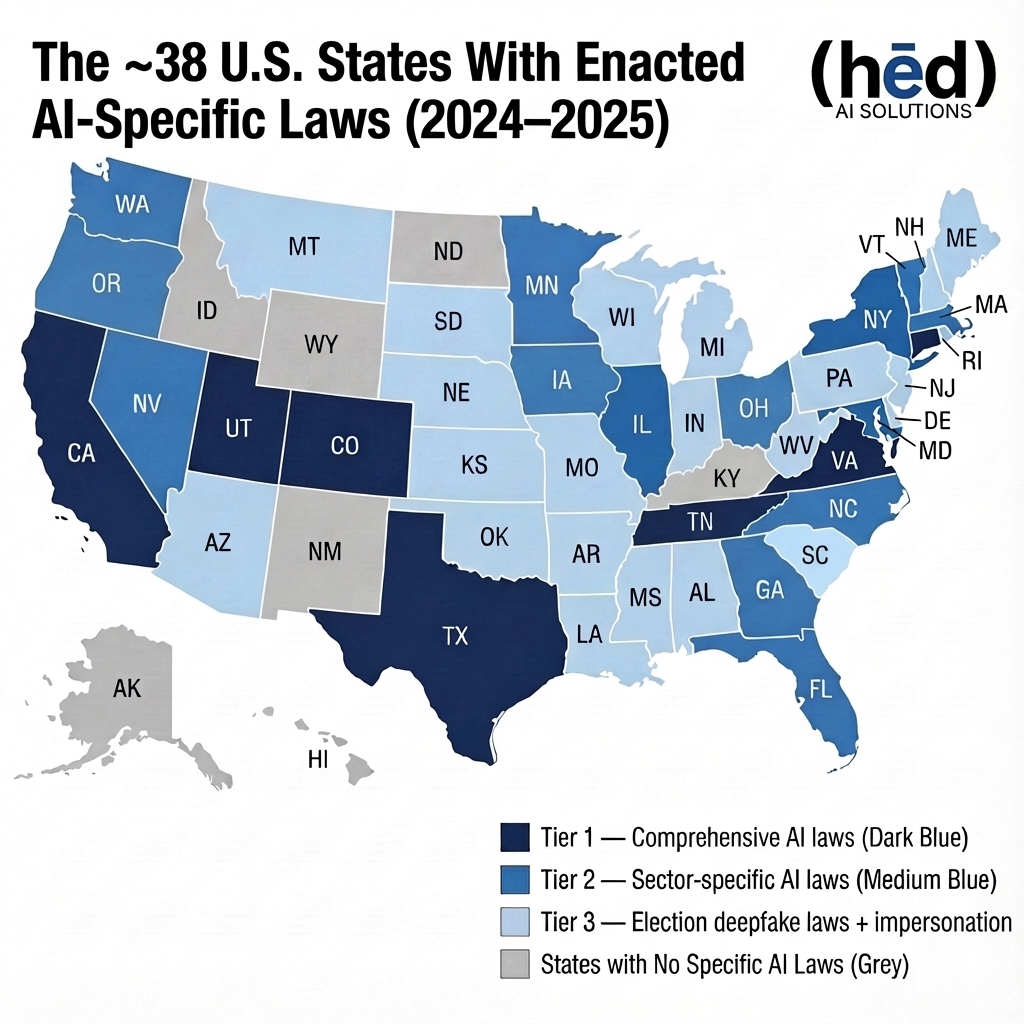
The 2024–2025 State-by-State Guide to U.S. AI Laws (Mapped & Explained)
The State of Practical AI for Small & Mid-Sized Businesses (2026 Edition)
Top AI Consulting Firms in Los Angeles: What to Look For & How to Choose