
CalMxBizForum25: Strengthening North American Competitiveness Through AI Governance, Enablement, and Cross-Border Collaboration
The California–Mexico Business Forum brought together business leaders, policymakers, and innovators from both sides of the border to address one central question: How do the U.S. and Mexico strengthen economic competitiveness in a future defined by AI?
Representing the Los Angeles Area Chamber of Commerce, I was invited to speak on the AI for Business Development Panel, joining a group of leaders discussing nearshoring, workforce readiness, and the new operational expectations created by enterprise AI adoption.
What emerged over the two-day forum was clear:
North America is rapidly moving toward a binational AI-enabled business environment—and firms that understand governance, enablement, and cultural alignment will have a competitive edge.
Heed AI’s Contribution: Bringing Governance, Practicality, and Enablement to the Table
My session focused on a growing challenge faced by organizations that want to work across borders:
AI adoption is accelerating faster than the readiness of workforces, policies, and governance frameworks.
Companies aren’t struggling with the idea of AI.
They’re struggling with:
- How to introduce AI safely and responsibly
- How to avoid compliance and data exposure risks
- How to align different cultures, languages, and workflows
- How to train teams—and train the trainers
- How to build AI solutions that align with global standards like ISO 42001
These gaps—skills, culture, governance, and operational alignment—are now determining which firms will succeed in serving international clients.
This is exactly where Heed AI Solutions operates.
Bridging Cross-Border Gaps Through AI Enablement
During the panel, I emphasized that AI itself is not the competitive advantage.
Enablement is.
AI becomes the cross-border bridge when organizations can:
1. Close Skills Gaps
Teams need practical, role-specific AI training—not generic “AI 101” workshops.
Heed’s enablement programs train teams in real workflows, using real processes, with real outcome expectations.
2. Close Culture Gaps
AI can unify cross-border operations only when both sides understand each other’s workflows, communication norms, and compliance expectations.
3. Close Language Gaps
AI doesn’t just translate—it standardizes.
Using agents and custom tools, teams can operate with shared context and shared understanding, regardless of native language.
4. Close Governance Gaps
Introducing AI without governance is equivalent to giving employees internet access without policies.
This is where ISO 42001—the world’s first AI management system standard—becomes a critical foundation.
I highlighted the practical reality:
Companies that begin aligning with ISO 42001 today will be ahead of RFP and regulatory requirements by the time those requirements become mandatory.
This message resonated strongly in the Mexico–U.S. context, where multinational partnerships must meet varying legal, operational, and privacy standards.
Why Binational Governance Matters
This was not my first time representing the U.S. and the Los Angeles Area Chamber on international AI governance.
I previously collaborated with Martin K. Breidsprecher Tamm on a panel discussing the EU’s approach to AI regulation—a conversation that resurfaced during this year’s forum.
The takeaway:
International clients will expect U.S. and Mexican firms to operate consistently and safely, aligning with:
- EU AI Act principles
- ISO 42001
- HIPAA/CCPA security frameworks
- Cross-border data handling standards
- Ethical AI usage expectations
Heed AI Solutions is already implementing systems that satisfy these standards—and training leadership teams to operationalize them.
This is why our approach resonates:
**We don’t just build AI tools.
We build governance-aware AI workflows, and we train your organization to use them the right way.**
Training the Trainers: The Future of AI Strength Across Borders
One of the strongest themes in our conversations was the need for internal champions on both sides of the border.
Organizations want:
- Internal AI ambassadors
- Departmental AI leads
- Trainers who carry knowledge forward
- Continuous AI literacy programs
- Long-term governance and workflow alignment
Heed AI Solutions specializes in exactly this model:
Pilot → Sprint → Training → Governance → Continuous Improvement
Our clients don’t just “adopt AI.”
They evolve into organizations that can sustain AI.
This is essential for binational operations where teams span time zones, languages, and regulatory environments.
A Message From the Forum
This year’s forum—supported by AEM USA, the Consulate General, the Los Angeles Mayor’s office, and the Chamber—was not just about trade or policy.
It was about building a shared future where California and Mexico operate as a unified economic region with AI as a strategic accelerator.
Across conversations with:
- Business owners
- Technologists
- Policy leaders
- Chambers of commerce
- Cross-border service providers
…one theme kept coming up:
There is massive opportunity for organizations that adopt AI responsibly, safely, and strategically.
Companies that combine:
- Governance
- Enablement
- Training
- Cross-cultural alignment
- Real workflows
- Human-in-the-loop oversight
…will be the ones who win the next decade of binational business.
Closing Thoughts
Being invited again—thanks to Martin K. Breidsprecher Tamm—to represent the Los Angeles Area Chamber of Commerce and the U.S. in discussions about AI governance is an honor. Seeing the growing commitment to responsible AI adoption across borders is a sign of the momentum ahead.
Heed AI Solutions is proud to be part of that movement—building systems, training leaders, and shaping the governance frameworks that will guide North American business for years to come.
Related posts
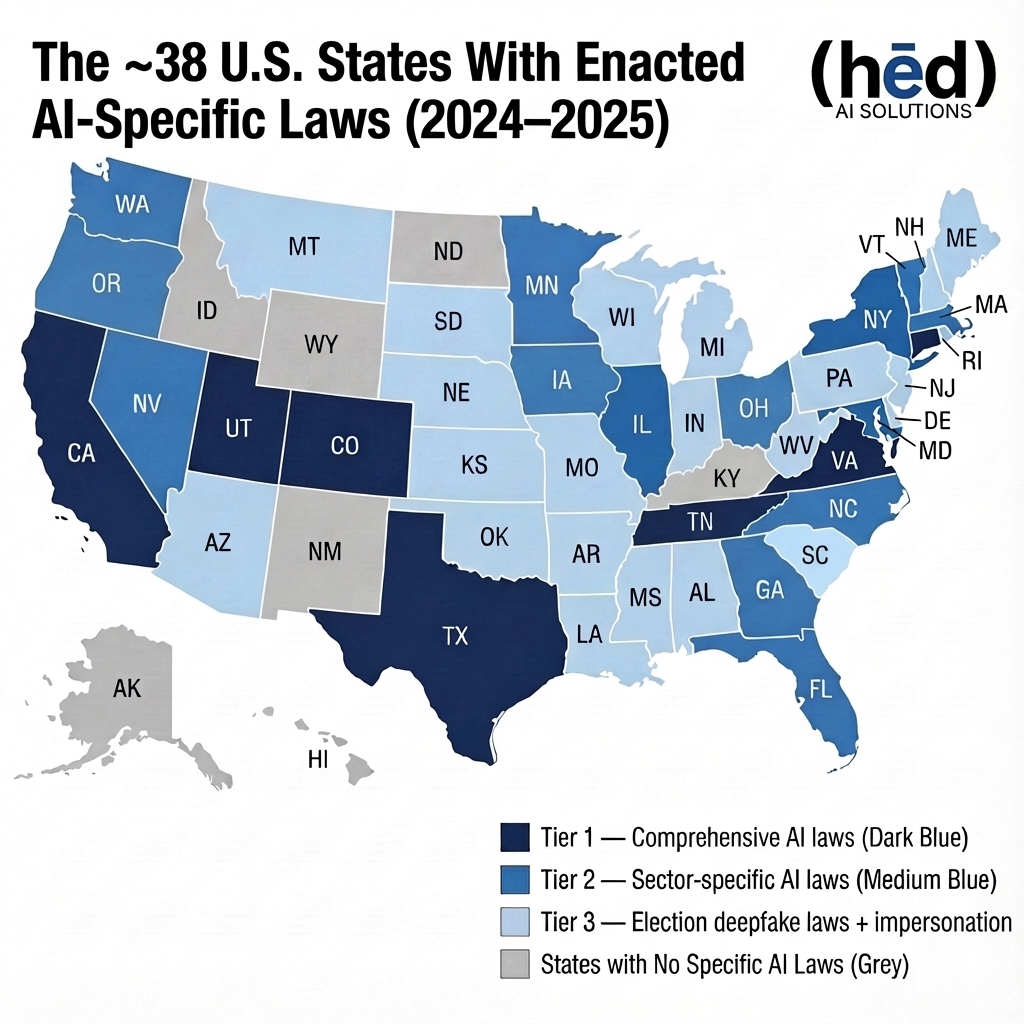
The 2024–2025 State-by-State Guide to U.S. AI Laws (Mapped & Explained)
California’s 18 New AI Laws:
The State of Practical AI for Small & Mid-Sized Businesses (2026 Edition)

Top AI Consulting Firms in Los Angeles: What to Look For & How to Choose