
The State of Practical AI for Small & Mid-Sized Businesses (2026 Edition)
How to move from curiosity to compliant, ROI-backed integration
By Michael Bowers, Heed AI Solutions
1. Why this guide exists
AI is no longer a science-fair demo.
By 2025, over half of U.S. small businesses report using AI, up sharply from low double-digits just two years earlier. Across large global surveys, roughly 9 in 10 SMBs that use AI say it has increased revenue and improved efficiency.
That’s the upside.
The other side of the table is where most owners and executives now sit:
- “Show me the actual payback period.”
- “How do we standardize this so it’s safe, not shadow-IT chaos?”
- “What will an auditor, regulator, or enterprise customer say about this?”
At the same time, the U.S. AI consulting services market is expected to grow from about $2.4 billion in 2024 to $13.3 billion by 2032, a 20%+ CAGR. In other words: the professional side of this market is already pricing AI like a serious operational discipline, not a toy.
This guide is built for the practical majority:
- Owners, CFOs, COOs, and practice managers who want time back and cleaner operations, not a buzzword slide.
- Boards and investors who want clear payback math and risk controls, not “innovation theater.”
- Chambers of commerce and local associations that need realistic talking points for member education.
You can use this document to:
- Frame a leadership offsite or board briefing on AI.
- Design a 2026 AI roadmap with credible numbers and governance.
- Pressure-test vendor pitches that promise “AI-powered everything” but never show their homework.
You should be able to act on this guide even if you never hire an outside firm.
2. Where small businesses actually are with AI
Let’s anchor in reality, not hype.
Recent surveys converge on a few key facts about AI in SMBs:
- Adoption is now mainstream. In 2025, 58% of U.S. small businesses say they use generative AI, up from 23% in 2023.
- Revenue impact is real. Multiple studies report around 91% of AI-using SMBs see revenue growth, and 80–90% say AI makes operations more efficient.
- Time and cash savings are measurable. In one small-business survey, owners reported saving 20+ hours per month and $500–$2,000 in monthly costs after adopting AI.
So the real 2026 questions are no longer:
“Should we use AI?”
They are:
“Where does AI fit in our workflows?”
“How do we govern it?”
“How quickly does each project pay for itself?”
This is the shift: from scattered chat usage to structured, governed integration.
3. What AI is actually doing for SMBs (beyond chat)
The SMBs seeing consistent ROI tend to use AI in four categories.
3.1 Automating back-office work
Target workflows:
- Accounts payable and receivable
- Expense and invoice processing
- Document intake and data entry
- Simple, rules-based reconciliations
Why these work so well:
- 80–90% of business data is unstructured—emails, PDFs, contracts, messages.
- Modern document-intelligence tools (Microsoft, Google, Azure, others) are designed to extract structured data from this mess.
A typical AP/AR agent for a 20–100 person firm will:
- Watch a shared inbox or folder for incoming invoices.
- Extract vendor, dates, amounts, line items, tax, and payment terms.
- Match them to purchase orders or contracts.
- Flag discrepancies and route only exceptions to a human.
- Push validated entries into QuickBooks, Xero, NetSuite, or your ERP.
Consistent benchmarks from finance and operations pilots show 10–25 hours per week of time recovery across clerks and reviewers when this work is standardized.
3.2 Improving how services are delivered
Professional services firms (legal, accounting, consulting, agencies) are using AI to:
- Draft first-pass analyses and memos from client documents.
- Pre-fill workpapers and checklists.
- Guide junior staff through repeatable workflows.
Healthcare and other regulated services use AI for:
- Intake summaries and basic documentation.
- Routing and triage (e.g., which department should see this first?).
- Compliance-safe reference to internal policies and guidelines.
In most cases, they didn’t rip out existing systems. AI sits on top of tools like Microsoft 365, Google Workspace, EHRs, and CRMs, enforcing standard ways of working instead of everyone reinventing their own process.
3.3 Sales and marketing enablement
The leading SMBs have moved beyond “write me a LinkedIn post.”
They use AI to:
- Auto-draft first-touch replies to inbound leads, personalized by source campaign, page visited, and basic firmographics.
- Generate proposals and quotes from standard templates, with built-in pricing rules and margin thresholds.
- Create educational drip sequences tuned to specific industries or personas.
- Maintain knowledge bases and FAQs that update as products or policies change.
Surveys of AI-using small businesses show double-digit percentage revenue lifts when AI is used systematically in sales and marketing, not just for one-off content.
3.4 Decision support and real-time insight
AI is also becoming an insight layer over your existing data:
- Daily KPI snapshots across cash, pipeline, support, and risk.
- Time-recovery dashboards that quantify hours saved and where to aim next.
- “Voice of customer” summaries from tickets, NPS comments, and reviews, distilled into 3–5 action items per month.
The goal isn’t dashboards for their own sake. It’s making better decisions days or weeks earlier than you would with manual reporting.
4. From tools to systems: AI agents, not just apps
Most companies start with tools:
- ChatGPT, Claude, Perplexity, Microsoft Copilot
- A few browser extensions
- “AI features” turned on inside CRM or accounting software
Those are fine as training wheels. But they rely on individual discipline: someone has to remember to open them and copy-paste data in and out.
The real inflection point is AI agents:
AI agents = AI wired into your systems, triggered by events, responsible for a repeatable outcome.
Examples:
- Invoice agent
- Trigger: vendor invoice lands in
ap@company.com. - Intake: pulls data from PDF, email body, and existing vendor records.
- Reasoning: compares to contracts and POs; validates amounts and terms.
- Action: posts to AP, creates tasks only for discrepancies over your threshold.
- Oversight: AP clerk reviews flagged items; controller reviews trend reports.
- Trigger: vendor invoice lands in
- Project-kickoff agent
- Trigger: deal moves to “Closed/Won” in HubSpot or Salesforce.
- Intake: reads deal details, client tier, and products sold.
- Reasoning: selects the right onboarding template.
- Action: creates folders, tasks, Slack/Teams channel, first client email, and initial invoice.
- Oversight: PM reviews and adjusts plan before client sees it.
Once you standardize a handful of patterns—trigger, intake, reasoning, action, oversight—you can reuse them across departments. That’s where AI becomes auditable, maintainable, and scalable, not a cluster of one-off experiments.
5. What “good ROI” actually looks like
Most AI discussions get lost in abstractions. You don’t need that.
5.1 Use a blended hourly rate
Pick a blended rate for your knowledge-worker staff. A common planning number for SMBs is:
$75/hour fully loaded (salary + benefits + overhead).
Then the math is simple:
- 1 hour/week saved ≈ 4.33 hours/month → ~$325/month in value.
- 7 hours/week saved (e.g., AP clerk + reviewer) → ~$2,275/month.
- 20 hours/month saved on reporting and document prep → ~$1,500/month.
Many bread-and-butter automations in finance, ops, and sales reliably fall in this range.
5.2 Payback period as the north star
CFOs and boards don’t want “efficiency.” They want payback periods.
Example:
- Build cost: $8,000 for an invoice agent.
- Time saved: 6–8 hours/week across clerk + reviewer.
- Monthly value at $75/hour: ~$2,000–$2,600.
Your payback period is roughly three months. After that, it’s pure time recovery and margin protection.
If the payback period is longer than 6–9 months, it probably shouldn’t be an early AI project.
6. Integration means governance: compliance isn’t optional
Once AI is handling real work—money, customer data, regulated tasks—governance moves from “nice to have” to “line item risk.”
The questions you should expect from regulators, enterprise customers, and your own board are consistent:
- Will this leak client or patient data?
- What happens when the AI is wrong?
- Can we show an auditor what the system does and how we supervise it?
- Who, today, owns this agent and its outputs?
Two reference points now matter for any serious implementation:
- NIST AI Risk Management Framework (AI RMF) – A U.S. government framework that helps organizations identify, measure, and manage AI risk (bias, robustness, privacy, security, explainability).
- ISO/IEC 42001 – The first international standard for an AI Management System (AIMS)—essentially ISO 9001/27001 but for AI. It outlines how to define roles, manage risks, document controls, and continually improve AI systems.
You don’t need certification on day one. But you do want to act as though an auditor could walk in next quarter and ask basic questions.
Minimum governance for any AI agent:
- Scope: What is this agent allowed to do, and what is explicitly out of bounds?
- Owners: One business owner and one technical owner, by name.
- Data map: What data does it see, where does it write, and who can change those connections?
- Controls: Human approval for high-risk actions (payments, legal decisions, regulated communications).
- Audit trail: Logging for inputs, key decisions, and outputs, retained for an appropriate period.
Large competitors are already winning deals with language like “HIPAA-appropriate automation,” “GDPR/CCPA-aware processes,” and “audit-ready AI workflows.” For many SMBs, this is becoming a sales requirement, not a luxury marketing line.
7. A practical 6-step roadmap for 2026
You don’t need a 100-page strategy deck. You need a disciplined sequence.
Step 1 – Set time and cash targets (not “AI goals”)
Start with waste you can see:
- Month-end close
- Invoice handling
- Proposal generation
- Intake and onboarding
- Basic reporting
For each, write down:
- Hours/week currently spent (estimate is fine).
- Who’s doing the work and what they cost.
- Target payback period (3–6 months is a good benchmark).
Now you have hard criteria for which ideas are worth pursuing.
Step 2 – Map one end-to-end workflow
Pick one workflow with these traits:
- Repetitive
- Mostly rules-based
- Painful enough that people will cheer if it’s improved
Examples:
- “Vendor invoice received → approved for payment in accounting system.”
- “Signed proposal → project kicked off with tasks, folders, and first client email.”
- “Web lead submitted → personalized response + intro call on calendar.”
Write or whiteboard the steps:
- What triggers the process?
- What systems are touched (email, CRM, spreadsheets, EHR, file storage)?
- Where are the delays, errors, or rework?
This is the blueprint for one AI agent, not a wish list for “AI everywhere.”
Step 3 – Design a governed pilot (2–4 weeks)
Treat the pilot like a limited-scope lab, not a permanent system.
For this one workflow:
- Limit to one team or business unit.
- Write clear rules:
- “AI may suggest draft emails, but a human must send them.”
- “AI may post draft entries to a staging ledger, but AP must approve before posting live.”
- Keep a simple pilot runbook:
- Purpose and scope
- Data sources and tools used
- Roles and responsibilities
- Approval points and escalation path
Pilot goal: prove value and safety, not perfection.
Step 4 – Run the pilot and measure
For ~30 days, track:
- Time spent before vs. after (even in rough terms).
- Error rates or exceptions.
- Satisfaction of the people actually doing the work.
Then compute:
Monthly value = hours saved × blended hourly rate
Compare that to your build cost:
- If the payback period is >9–12 months, fix the design or kill it.
- If it’s ≤6 months, you have a candidate for wider rollout.
The discipline here is what separates serious operators from “we tried AI once and it didn’t work.”
Step 5 – Sprint: integrate, orchestrate, and harden (4 weeks)
If the pilot works, treat the next phase as a 30-day sprint:
- Connect more systems (CRM + accounting + file storage + support).
- Add exception handling and approval logic.
- Move from a sidecar tool to a fully embedded agent in the workflow.
You still keep oversight:
- Thresholds for auto-approval vs. human review.
- Clear logs.
- Rollback options if something behaves unexpectedly.
The sprint’s output should be:
- A stable, documented agent in production.
- An ROI summary with time/cash impact.
- A governance summary aligned (even lightly) to NIST AI RMF and ISO 42001 concepts.
Step 6 – Move to a managed model
Once you have a few agents earning their keep, treat them like any other critical system.
That means:
- Named owners (business + technical) for each agent.
- Monthly or quarterly reviews of:
- Logs and exceptions
- Model performance and drift
- Changes in upstream systems (new ERP, CRM fields, policy changes)
- A simple change-management process:
- How prompts, rules, and data sources are updated
- How new use cases are prioritized
- How old agents are retired when no longer needed
This pilot → sprint → managed pattern is the same structure professional AI shops use for serious clients because it balances speed, safety, and measurable ROI.
8. Questions every SMB leader should be asking in 2026
Whether you build internally or hire outside help, these are the questions that matter.
Value and prioritization
- What are the top three workflows to automate based on hours and dollars, not hype?
- For each initiative, what is the target payback period?
Data and privacy
- What data does each AI system see—specifically?
- How are PII, PHI, and financial data protected, redacted, or kept on-prem?
- Which AI services run inside your cloud tenant vs. outside vendors?
Controls and accountability
- Who is the business owner and technical owner for each agent?
- Where is the documentation stored, and who keeps it up to date?
- Who is allowed to change prompts, rules, or system connections?
Compliance and audit-readiness
- Are you aligning—at least lightly—with NIST AI RMF and ISO/IEC 42001 as you scale?NIST+2ISO+2
- Could you show an auditor what each agent does, what data it uses, and how you oversee it?
People and change
- How are you training staff to use AI safely and effectively?
- Are you tracking time recovered and making a deliberate choice:
- Reduce overtime?
- Increase capacity?
- Redirect people to higher-value work?
These questions are the difference between “we’re dabbling in AI” and “we’ve standardized AI as part of how we operate.”
9. How to actually use this guide inside your organization
Here’s how to turn this document into action in the next 30–90 days.
A. Leadership offsite (90 minutes)
Use Sections 3–8 as your agenda:
- 15 min – Agree on where AI is already being used (even informally).
- 30 min – Identify 5–10 candidate workflows across finance, ops, and sales.
- 30 min – Choose one pilot with clear time/cash math.
- 15 min – Assign owners and a basic timeline.
B. Department workshops (2 hours each)
Run separate sessions with:
- Finance & accounting
- Operations / service delivery
- Sales & marketing
- Compliance / IT (if applicable)
For each, ask:
- “Top 5 repetitive processes you’d gladly never do again.”
- “Rough hours per week spent on each.”
- “Worst-case cost if this is done late or wrong.”
Convert the answers into a ranked backlog of potential AI projects.
C. Vendor and partner evaluation
When a vendor says “AI-powered,” ask:
- What workflow does this actually automate end-to-end?
- What is your documented payback period for customers like us?
- How do you handle data residency, privacy, and model governance?
- How do you support audit trails and alignment with NIST/ISO standards?
If they can’t answer those questions plainly, they’re not ready to own part of your operating system.
D. Board or investor update (1–2 pages)
Summarize:
- Where AI is currently in use (even informally).
- The next 2–3 workflows you plan to target.
- The governance measures you’re putting in place.
- The expected payback periods for each initiative.
Your message: AI is being treated as a time and risk discipline, not a toy.
10. Closing and (optional) next step
AI has become part of the standard toolkit for businesses of every size—from solo practitioners to suppliers serving Fortune-level customers.
The gap in 2026 is not “who has access to AI.” The gap is:
- Who has a clear sequence (pilot → sprint → managed).
- Who can show a board or auditor where the ROI comes from and how risk is handled.
- Who treats time as the scarce asset they are protecting and recovering.
If this guide helps you:
- Identify a few high-value workflows,
- Clarify how you’ll measure time recovery and payback, and
- Start building a lightweight but real governance layer,
…then it has done its job.
If you’d like a working session to design or stress-test your AI adoption blueprint—with a focus on time recovery, standards, and measurable ROI—you’re welcome to reach out:
Author
Michael Bowers, President, Heed AI Solutions
📞 310-363-0826
📅 Schedule a conversation here
Either way, treat time as the asset you’re protecting.
AI is simply the stack of tools and agents you use to standardize, automate, de-risk, and measure how you win that time back.
Notes & sources (for further reading and link-sharing)
- Salesforce – SMB AI Trends (2024–2025). Global surveys of 3,350 SMB leaders: 91% of AI-using SMBs report revenue growth; ~90% report efficiency gains.Salesforce+2Salesforce+2
- U.S. Chamber of Commerce – “Empowering Small Business: The Impact of Technology on U.S. Small Business” (2025) and related coverage – 58% of small businesses now report using generative AI, up from 40% in 2024 and 23% in 2023.U.S. Chamber of Commerce+1
- CPA Practice Advisor – “AI Momentum Belongs to Small Business” (2025). Reports 91% of SMBs using AI see revenue boosts; 20+ hours/month saved and $500–$2,000 in cost savings.CPA Practice Advisor
- SNS Insider / Yahoo Finance – AI Consulting Services Market (2024–2032). U.S. AI consulting services market valued at ~$2.42B in 2024, projected to reach ~$13.28B by 2032; global market projected to $49.1B by 2032.Genspark+3Yahoo Finance+3SNS Insider+3
- NIST – Artificial Intelligence Risk Management Framework (AI RMF 1.0) and Resource Center. Official U.S. guidance for identifying and managing AI risks.NIST+2NIST Publications+2
- ISO / Microsoft / KPMG – ISO/IEC 42001:2023 Artificial Intelligence Management System (AIMS). First international standard for AI management systems and governance.ISO+2Microsoft Learn+2
- IDC, IBM, and others on unstructured data. Widely cited estimates that 80–90% of the world’s and enterprises’ data is unstructured, underlining the importance of AI-driven document and content processing.Cota Capital+2Snowflake+2
- Additional SMB AI ROI analyses. Various 2025 articles summarizing that 90%+ of AI-using SMBs report year-over-year ROI, with strong gains in revenue, cost savings, and scalability.HR Executive+2
Related posts
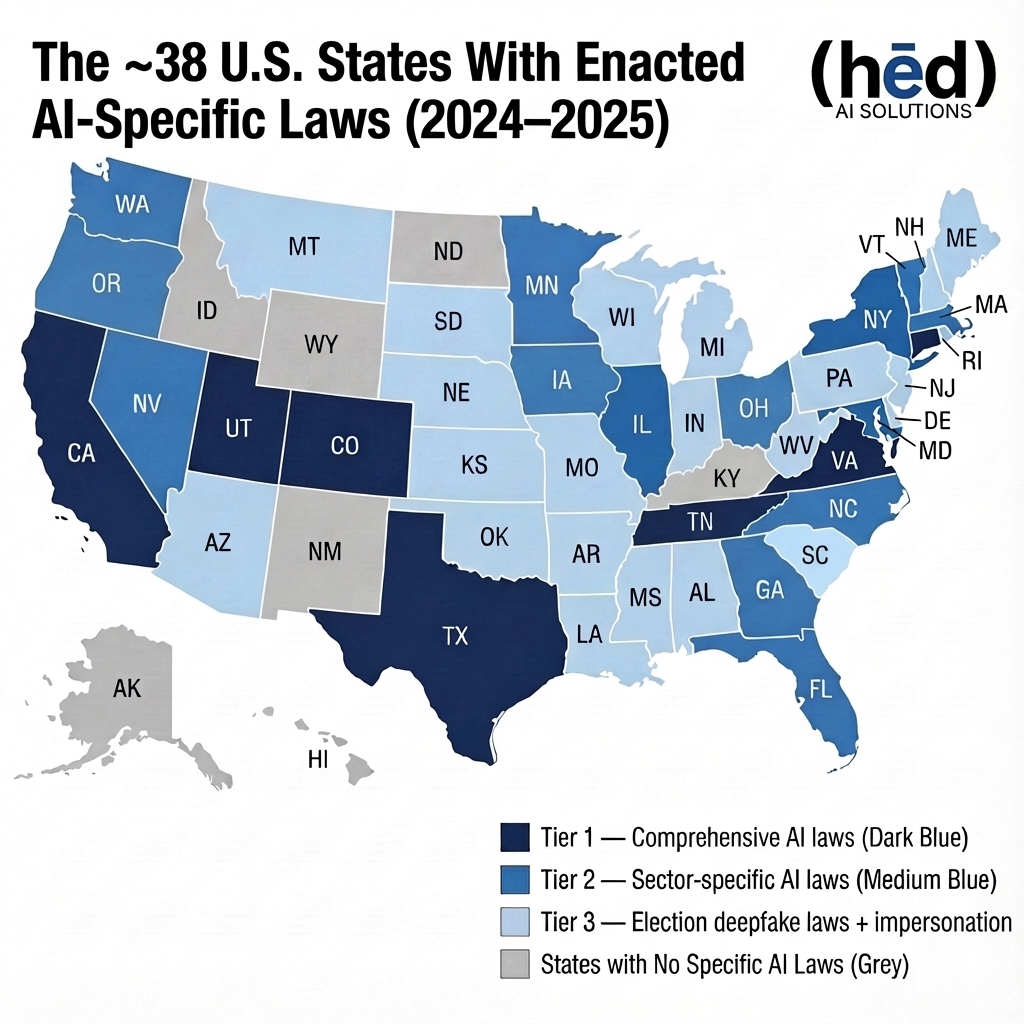
The 2024–2025 State-by-State Guide to U.S. AI Laws (Mapped & Explained)
California’s 18 New AI Laws:
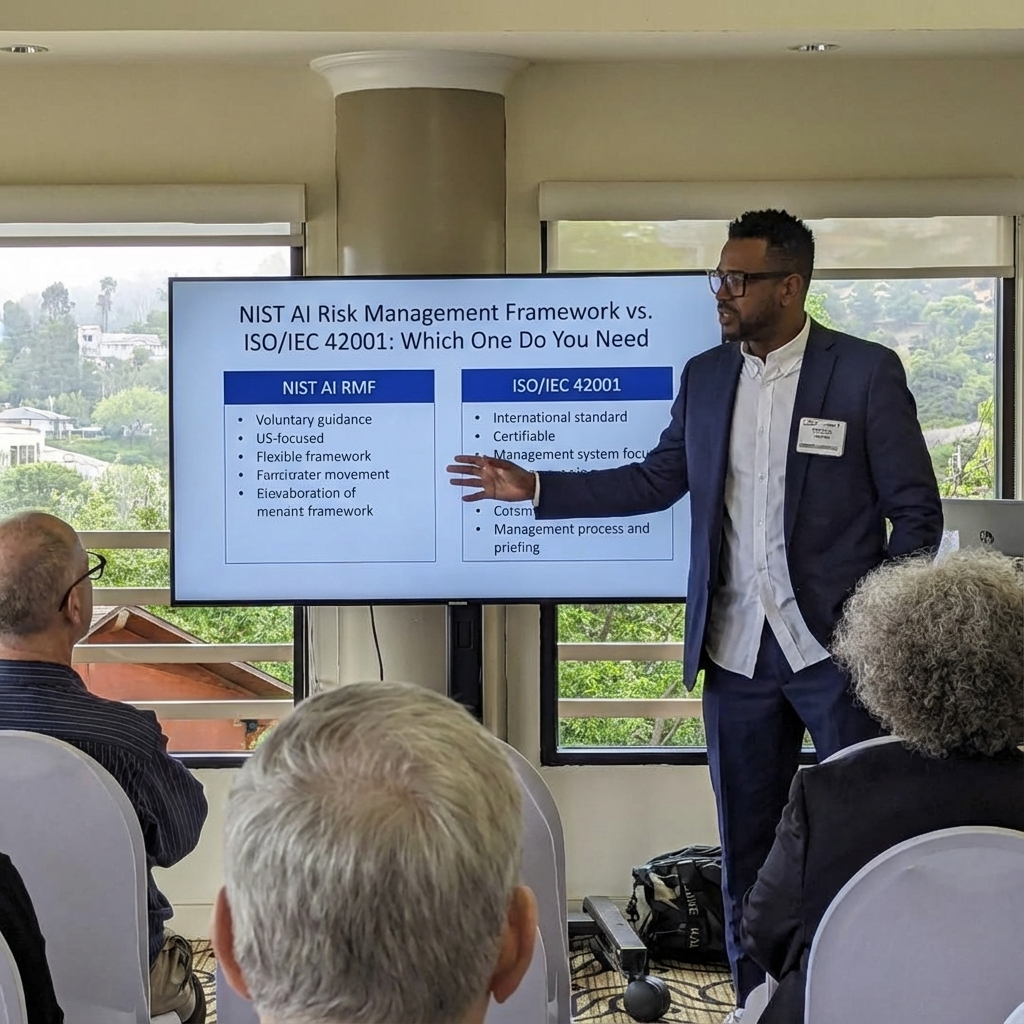
NIST AI Risk Management Framework vs. ISO/IEC 42001: Which One Do You Need?