
What Workflows Can Be Fully Automated with GPT for Business?

Most teams think GPT is for drafting emails or summarizing documents. But GPT-powered automation handles end-to-end workflows: reading invoices, cross-checking policies, routing approvals, logging audit trails—without human intervention beyond exception handling.
For finance teams drowning in AP/AR, sales reps manually enriching leads, or ops leaders chasing compliance documentation, GPT eliminates the repetitive judgment calls that traditional RPA can’t handle.
This guide covers 12 workflows we’ve automated for clients, the tech stack required, proof metrics, and a decision framework for what to automate first. By the end, you’ll know whether your bottleneck is a candidate for full automation or still needs human oversight.
What Makes a Workflow “Fully Automatable”?
A workflow can run end-to-end with GPT when it has:
- Structured inputs: Emails, PDFs, forms, CRM records
- Clear policy rules: “Approve if within budget and PO matches”
- Defined escalation paths: “Flag variances >10% for controller”
- Audit requirements: Logging who/what/when for compliance
Not automatable (yet):
- Negotiations requiring empathy
- Creative strategy (brand positioning, product design)
- High-stakes decisions without fallback (legal settlements, M&A)
Gray area (human-in-the-loop):
- Contract redlines (GPT flags issues; lawyer approves)
- Customer refunds (GPT suggests resolution; manager confirms)
12 Workflows You Can Fully Automate
1. Invoice Processing & AP Automation
How it works:
- GPT reads invoice PDF (vendor, amount, line items)
- Matches PO in QuickBooks or NetSuite
- Flags variances (price mismatch, missing PO)
- Routes to approver if threshold exceeded
- Posts approved invoices to accounting system
- Logs audit trail (who approved, timestamp, variance reason)
Tech stack: Make/Zapier + GPT-4 + QuickBooks API
Proof: 38% faster cycle time; 99.5% match accuracy
Best for: Finance teams processing 50+ invoices/month
2. Lead Enrichment & Qualification
How it works:
- Inbound lead submits form (name, company, pain point)
- GPT scrapes LinkedIn, company website, Crunchbase
- Scores intent (budget signals, tech stack, org size)
- Enriches HubSpot record (industry, revenue estimate, decision-maker title)
- Routes to rep with context: “CFO at $20M SaaS co; mentioned ‘invoice backlog’”
- Tech stack: Make + GPT-4 + HubSpot API + Clearbit/Apollo
- Proof: 60% faster lead response; 22% higher demo-show rate
- Best for: Sales teams with 20+ inbound leads/week
3. Customer Support Ticket Triage
How it works:
- Customer emails support (subject: “Billing issue”)
- GPT reads email, classifies urgency + category
- Checks knowledge base for resolution steps
- Drafts response (“Your invoice was sent to [email]; attached PDF”)
- Escalates to human if no KB match
- Tech stack: Zapier + GPT-4 + Zendesk/Intercom API
- Proof: 40% reduction in first-response time
- Best for: CX teams handling repetitive inquiries (password resets, billing questions)
4. Expense Report Review & Approval
How it works:
- Employee submits expense report (PDF or form)
- GPT extracts line items, categories, totals
- Cross-checks policy (per diem limits, receipt requirements)
- Flags violations (“Hotel $350/night; policy max $250”)
- Auto-approves compliant reports; routes exceptions to manager
- Tech stack: Make + GPT-4 + Expensify/Concur API
- Proof: 70% of reports auto-approved; 3 hours saved/week (controller)
- Best for: Teams with 10+ expense reports/month
5. Meeting Notes → Action Items & CRM Updates
How it works:
- GPT transcribes meeting (Zoom, Teams, Google Meet)
- Extracts action items, owners, deadlines
- Updates HubSpot deal stage (“Demo completed; proposal due Friday”)
- Posts summary to Slack/Teams
- Adds calendar reminders for follow-ups
- Tech stack: Zapier + GPT-4 + Zoom API + HubSpot
- Proof: 20 minutes saved per meeting; zero missed follow-ups
- Best for: Sales, ops, project teams with 5+ meetings/week
6. Contract Review & Compliance Checks
How it works:
- Legal uploads contract (PDF)
- GPT scans for non-standard clauses (indemnification, liability caps, auto-renewal)
- Flags deviations from company template
- Suggests redlines with explanations
- Logs review in matter management system
- Tech stack: Make + GPT-4 + DocuSign/PandaDoc API
- Proof: 50% faster first-pass review; 90% fewer missed clauses
- Best for: Legal/compliance teams reviewing 10+ contracts/month
- Note: Human lawyer still signs off—GPT accelerates triage.
7. Accounts Receivable Follow-Up
How it works:
- GPT checks overdue invoices in QuickBooks (30/60/90 days)
- Drafts personalized follow-up email (references original invoice, payment terms)
- Sends via Gmail/Outlook
- Logs touchpoint in CRM
- Escalates to collections if 90+ days overdue
- Tech stack: Make + GPT-4 + QuickBooks + Gmail API
- Proof: 15% faster collections; consistent follow-up cadence
- Best for: Finance teams with 20+ AR accounts
8. Job Applicant Screening & Scheduling
How it works:
- Applicant submits resume + answers screening questions
- GPT scores fit (required skills, experience level, location)
- Sends rejection or interview invite
- Proposes 3 calendar slots (checks hiring manager availability)
- Logs in ATS (Greenhouse, Lever)
- Tech stack: Zapier + GPT-4 + Calendly + Greenhouse API
- Proof: 80% of screening automated; 2 hours saved per open role
- Best for: HR/recruiting teams hiring 5+ roles/year
9. SOP Generation from Meeting Transcripts
How it works:
- Ops lead records process walkthrough (screen share + narration)
- GPT transcribes video
- Structures SOP (step-by-step, decision trees, screenshots)
- Formats in Notion/Confluence
- Adds version control metadata
- Tech stack: Make + GPT-4 + Notion API + Loom
- Proof: 60% faster SOP creation; consistent formatting
- Best for: Ops/compliance teams documenting processes
10. Sales Proposal Drafting
How it works:
- Rep fills form (prospect name, pain points, budget)
- GPT pulls pricing, case studies, FAQs from SharePoint/Google Drive
- Drafts custom proposal (scope, timeline, investment)
- Generates PDF with branding
- Sends via DocuSign for e-signature
- Tech stack: Make + GPT-4 + PandaDoc API + HubSpot
- Proof: 45 minutes → 8 minutes per proposal
- Best for: Sales teams sending 5+ proposals/month
11. Compliance Audit Documentation
How it works:
- Auditor requests evidence (e.g., “Show all vendor approvals Q3 2024”)
- GPT searches accounting system, email archives, SharePoint
- Compiles report (transaction logs, approver names, timestamps)
- Generates PDF with hyperlinks to source documents
- Logs request in audit tracker
- Tech stack: Make + GPT-4 + QuickBooks + Google Workspace API
- Proof: 4 hours → 30 minutes for standard audit requests
- Best for: Finance/compliance teams facing quarterly/annual audits
12. Vendor Onboarding & W-9 Collection
How it works:
- New vendor submits onboarding form
- GPT validates W-9 (TIN format, signature, expiration)
- Checks vendor against sanctions lists (OFAC)
- Creates vendor record in accounting system
- Sends welcome email with payment terms
- Tech stack: Zapier + GPT-4 + QuickBooks API + IRS TIN lookup
- Proof: 90% of vendors auto-onboarded; zero missed W-9s
- Best for: AP teams adding 5+ vendors/month
Tech Stack Overview
Most workflows use this modular stack:
| Component | Tools | Role |
|---|---|---|
| Orchestration | Make, Zapier, n8n | Connects apps, triggers workflows |
| AI Engine | GPT-4, Claude, Gemini | Reads, reasons, drafts, extracts |
| Data Sources | HubSpot, QBO, Gmail, SharePoint | Where inputs live |
| Outputs | Slack, email, CRM, accounting sys | Where results go |
| Audit/Logging | Airtable, Google Sheets, database | Tracks who/what/when for compliance |
Key principle: We build in your environment (no vendor lock-in). You own the workflows.
Decision Framework: What to Automate First
Prioritize workflows with:
- High volume: >10 instances/week
- Repetitive judgment: “Does this match policy?” (not “Should we acquire this company?”)
- Clear inputs: Structured data (invoices, forms, CRM records)
- Measurable bottleneck: “Controller spends 5 hours/week on this”
- Audit trail required: Finance, compliance, HR workflows
Start here:
- AP invoice approvals (if processing 50+/month)
- Lead enrichment (if 20+ inbound/week)
- Expense report review (if 10+/month)
Avoid (for now):
- One-off strategic decisions
- Workflows requiring emotional intelligence (layoffs, customer de-escalation)
- Unstructured inputs (handwritten notes, videos without transcripts)
Implementation Checklist
- Map current workflow (steps, handoffs, exceptions)
- Identify policy rules (approval thresholds, compliance checks)
- Define escalation triggers (when to alert human)
- Choose tech stack (Make + GPT + your systems)
- Build pilot (10–20 instances)
- Measure KPIs (cycle time, accuracy, escalation rate)
- Roll out with SOPs + role training
- Review monthly: what breaks? What improves?
FAQs
- Can GPT replace my entire team?
- No. GPT automates repetitive judgment calls—freeing your team for strategy, exceptions, and relationship work. Think “augmentation,” not replacement.
- What if GPT makes a mistake?
- Every workflow includes escalation rules. Example: “If invoice variance >10%, alert controller.” We track error rates and tune prompts until accuracy exceeds human baseline.
- Do I need developers to build these?
- Not for most workflows. Make/Zapier offer no-code interfaces. Complex integrations (custom APIs, database queries) may need light scripting—we handle this in sprints.
- How long does automation take to build?
- Pilots: 2–4 weeks. Production-ready: 4–8 weeks (includes testing, SOPs, training).
- What’s the ROI payback window?
- Most workflows pay back in 2–4 months. Example: $6K sprint saves 10 hours/week (4 people × 2.5 hrs) → $50/hr → $2K/month value.
- Can I automate workflows across multiple systems?
- Yes. GPT workflows often chain HubSpot → QuickBooks → Slack. Orchestration tools (Make) handle cross-system handoffs.
See which workflows you should automate first.
→ Get Your AI-BD Blueprint or Start an Automation Sprint
Facebook
X
LinkedIn
Email
Print
Related posts
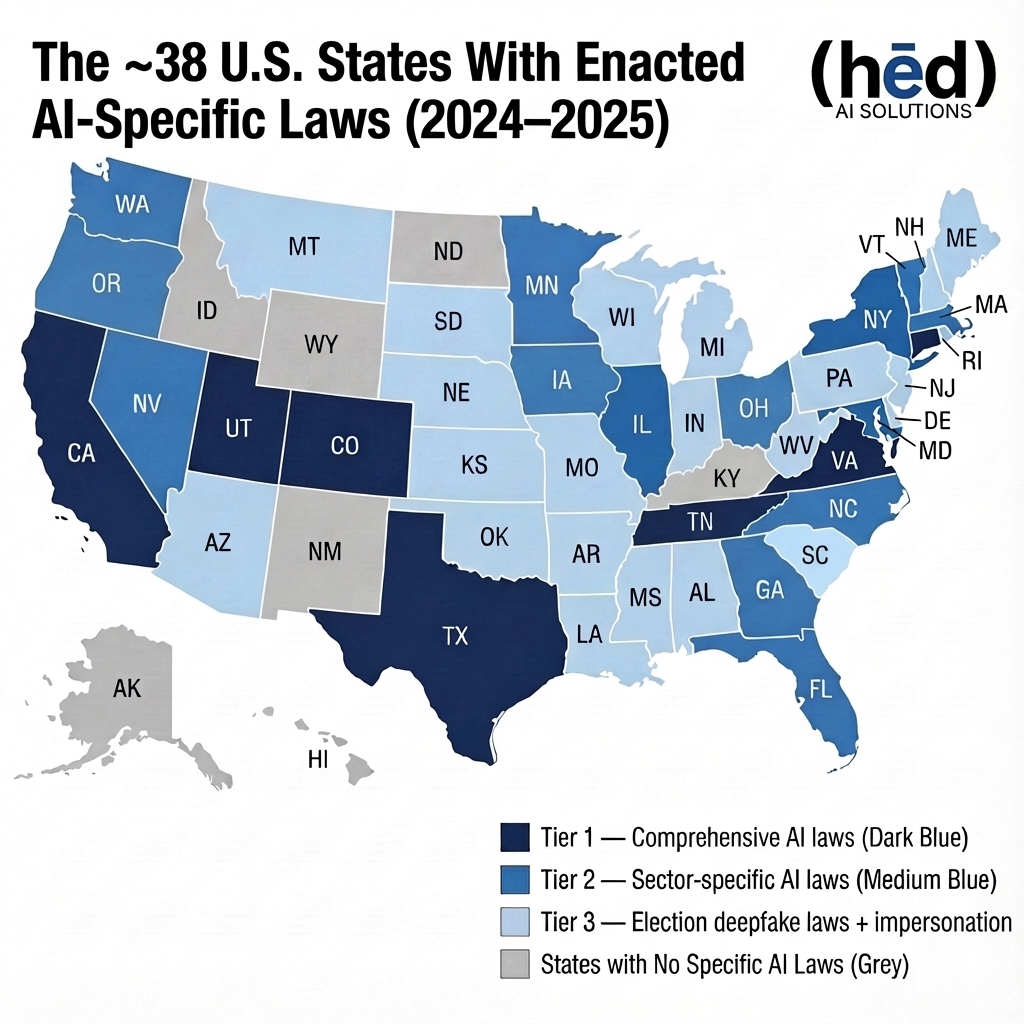
The 2024–2025 State-by-State Guide to U.S. AI Laws (Mapped & Explained)
California’s 18 New AI Laws:
The State of Practical AI for Small & Mid-Sized Businesses (2026 Edition)

Top AI Consulting Firms in Los Angeles: What to Look For & How to Choose