The daily
reconciliation engine
Heed AI Solutions
Preparing sequence 000%

For CFOs and controllers of multi location businesses

Right now, nobody can tell you how much money is missing.

Not because your team is careless. Because cash, cards, and customer financing reach the bank on three different clocks, and the one person who can untangle them is doing it by hand, one morning at a time.

Day oneOne 47 store group reconciled more than half a million dollars on the first morning its team used this

01 / What the CFO inherits

You cannot sign off on numbers you cannot trace.

Cash, cards, and customer financing all reach the bank on different days. Until every store day is tied to a deposit, your cash position is an estimate, the close drags, and nobody can tell you how much is actually missing rather than simply late.

01Over $1,000,000 sat unreconciled when the incoming CFO asked the question

02 / What the controller does

Five exports, one spreadsheet, every single morning.

Daily cash drawer totals, bank activity, card batches, the financing report, and invoice level tender. None of them agree on dates, and the rules that make them agree live in one person's head.

02Weekend card settlements bundle into Monday, and one location banks on its own

03 / What it costs you

It is a single point of failure.

Hours every morning, a coverage plan whenever that person takes leave, and a thirty tab workbook stacked on top at month end. When the person who knows the rules leaves, the rules leave with them.

“It’s just copy and paste. Yeah.”

04 / What we built

Those rules, written down once, in software.

Your team drags the same exports onto a page. The engine matches every store day against the bank on its real funding calendar, applies the weekend and cutoff rules automatically, and never guesses. Nothing is ripped out and nothing new has to be integrated.

ResultThat $1,000,000 fell to $435,000 on the first day the team used it

05 / What you get

One short list, every morning.

The stores where money is genuinely missing, each row explained and, wherever the record allows, pinned to the sale behind it. Everything else is already closed and evidenced.

How it works

How a day actually gets closed, step by step.

Six stops from the exports landing in your controller's inbox to the short list on your screen. This is the whole method, with nothing left out.

Stop one / The question

All 39 locations closed yesterday. Did every dollar reach the bank?

It sounds like a question with a quick answer. It is not. The money left those stores as cash, on cards, and through a consumer financing program, and each of those travels a different road to the account, on a different timetable.

Stop two / Five sets of books

The answer is scattered across five exports that never quite agree.

Daily cash drawer totals. Bank activity. Card batches. The financing report. Invoice level tender. Five files, five formats, five different clocks, and not one of them is wrong. They simply do not line up on the same day.

Stop three / The rules nobody wrote down

Friday and Saturday settle on Monday. A late batch lands the next banking day.

One location banks on its own. The financing program pays a single lump sum for everyone, net of fees. Holidays move all of it. These rules live in somebody's head, and they are the reason most mismatches are not mismatches at all.

Stop four / The bridge is a person

So somebody matches it by hand, every single morning.

It takes hours, it is never quite finished, and it quietly makes one person the only one who understands how any of it works. When that person leaves, the knowledge leaves with them.

Stop five / The engine

The rules get written down once, in code.

Every store, every day, matched against the bank on its real funding calendar. Exact math and stated rules, and never a guess. When a row cannot be explained honestly, it says so plainly instead of inventing an answer.

Stop six / The short list

What is left is what is genuinely wrong.

Each unmatched row arrives with its reason attached and, wherever the record allows, pinned to the exact sale behind it. Items escalate on their own at day three and day five, so nothing needs chasing and nothing quietly ages.

Every morning ends the same way now. One short list.

Before the second cup of coffee the day is closed, the exceptions are named, and the person who used to carry all of it has their morning back.

Map your reconciliation

What it does every morning.

Built alongside the accounting team that does the work. Their rules became the engine, session by session, screenshot by screenshot. More than forty releases shipped in two weeks.

1 day
From kickoff working session to live, secured software
40+
Numbered releases shipped in two weeks
$1M to $435K
Unreconciled deposits, in a single day of use
~2 sec
Upload confirmation, with matching running behind it

Rail 01Cash and ATM deposits

Matched to the bank on a realistic window of banking days, with a grace amount, branch depositor handling, and each store's quirks encoded. Sundays and bank holidays are excluded from the count automatically.

Rail 02Card settlements

Matched on their true funding calendar. Weekend bundles, nightly cutoff splits, late funders and next day netting are all handled automatically and explained in plain English on the row itself.

Rail 03Financing program deposits

One company lump sum decomposed into per store expectations with exact fee math, then cross checked against the processor's own daily report, which predicts the bank credit to the penny one banking day out.

ExceptionsThey explain themselves

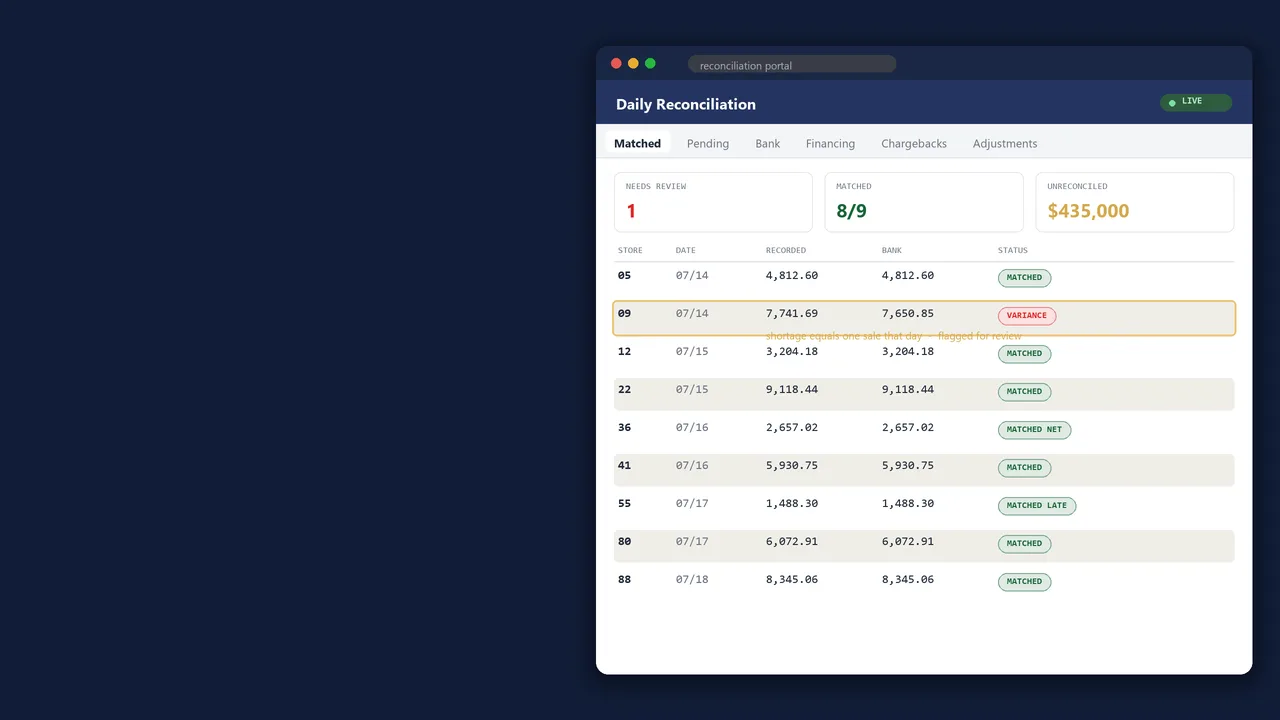
A shortage gets pinned to the single invoice that caused it, so the store makes one phone call. A sale rung on the wrong payment type gets flagged with the matching offset suggested. Two processor funding shortfalls, $607.58 and $862.19, were caught to the penny and documented.

ControlsOne click, fully attributed

Link, offset, write off, unpair, correct a source number. Every action records who did it and when, and every action can be undone. Month end write offs become a clean printable report instead of archaeology.

EscalationLeadership sees one list

Items that sit unresolved move up on their own, to the team at day three and to leadership at day five. The company president sees exactly one thing: the stores where money is genuinely missing.

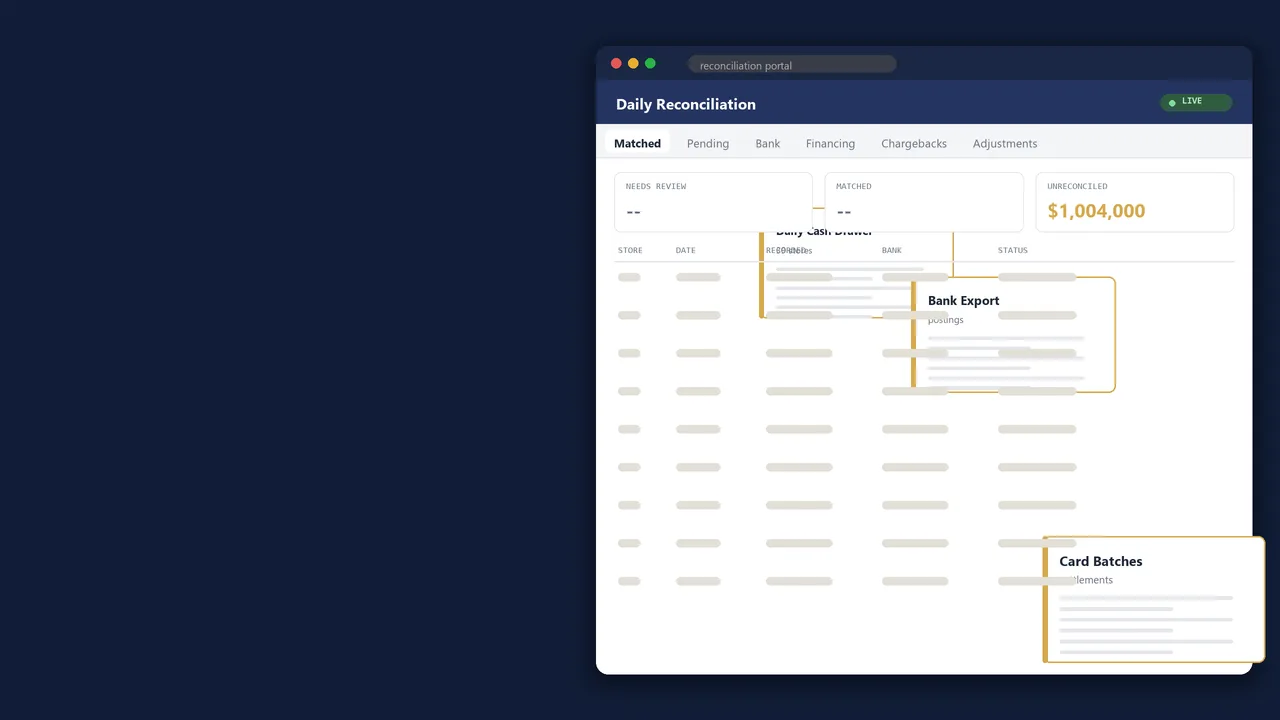
Five source documents labelled daily cash drawer, bank export, card batches, financing report and sales tender arriving toward the reconciliation dashboard
Five exports arriveF 0026
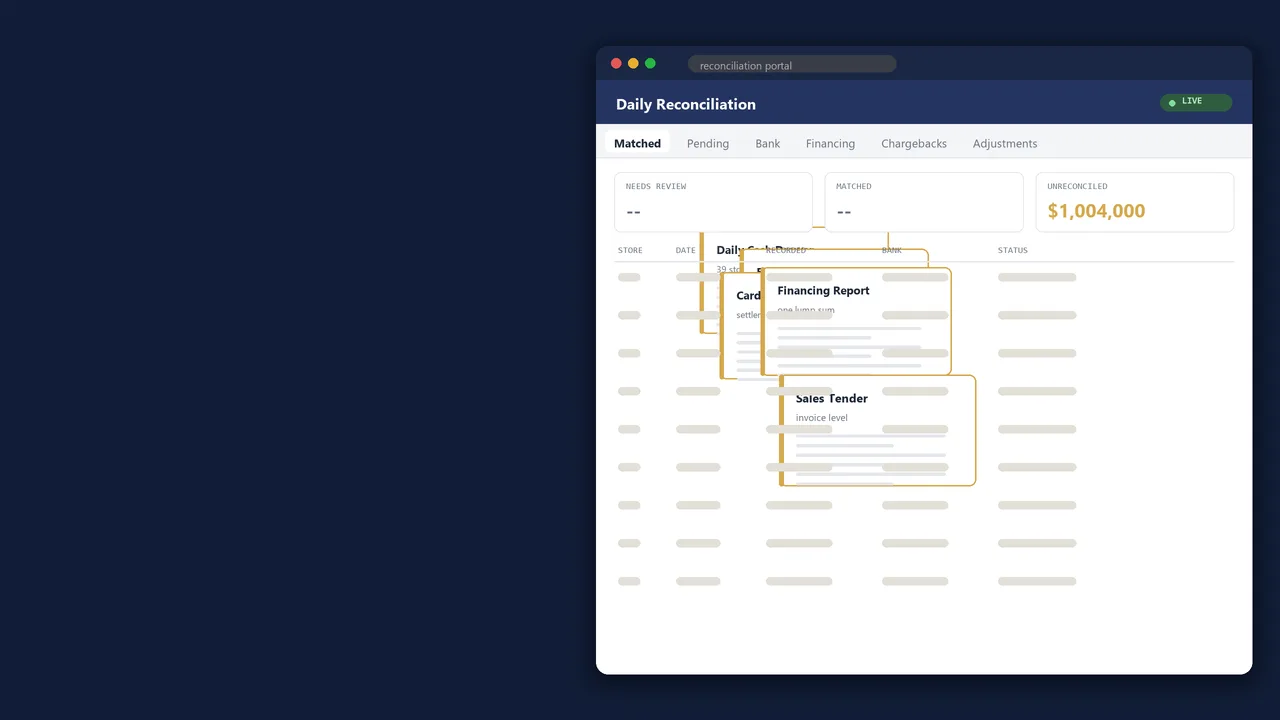
The five source documents stacked together inside the dashboard window as the table begins to fill
One placeF 0050
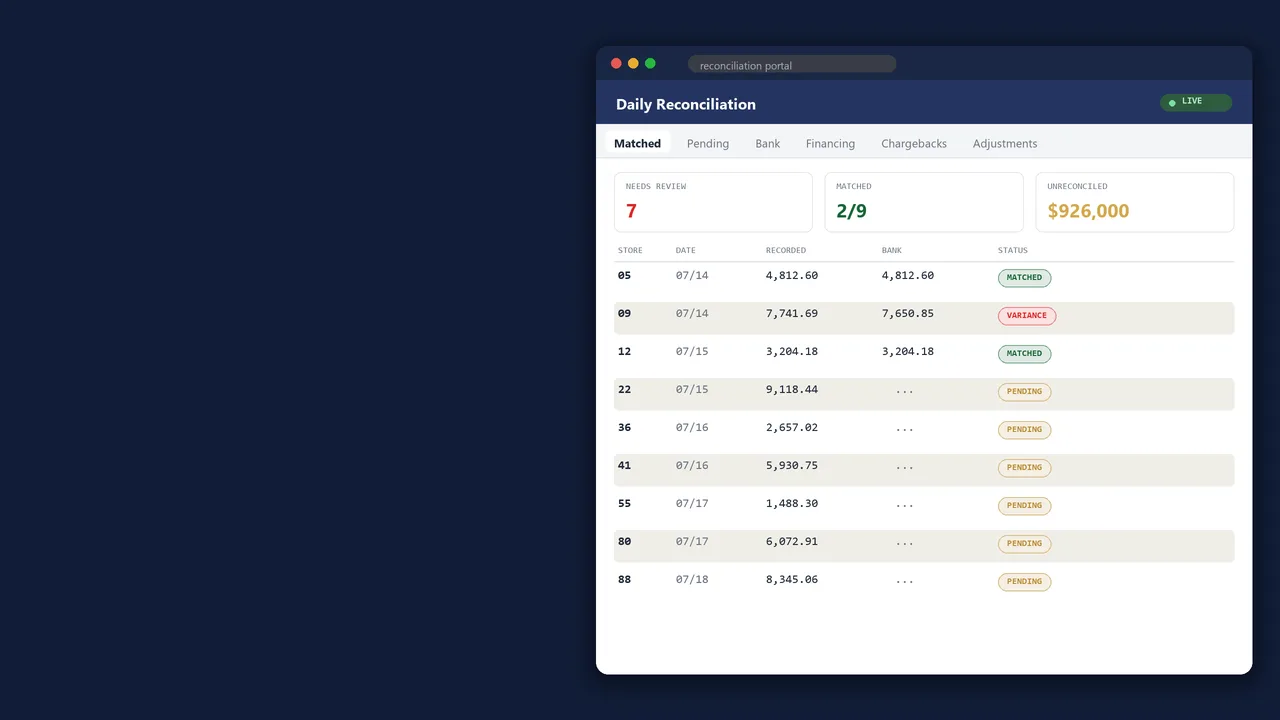
Dashboard rows resolving from pending to matched with the unreconciled figure falling
Matching runsF 0086
The finished dashboard showing eight of nine rows matched and one variance row ringed for review
One short listF 0118

Built for the two people who carry this

Reconciliation fails in two different ways depending on where you sit. This was built with both seats at the table, working session by session with the people who actually close the day.

The CFO

You need numbers you can defend

You get asked for a cash position, a close date, and a figure for what is genuinely missing. Right now all three rest on one person's spreadsheet and one person's memory.

  • A daily figure for unreconciled cash instead of a monthly estimate
  • Every match evidenced, attributed, and reversible for your auditor
  • Exceptions that escalate on their own at day three and day five
  • A close that no longer waits on one person being available
Get the assessment
The controller

You need your mornings back

You already know the rules. You apply them by hand across five exports before anyone else is awake, and the backlog grows on any day you cannot get to it.

  • Drag in the exports you already pull, in the formats they arrive in
  • The weekend, cutoff, and financing rules applied for you every time
  • A shortage pinned to the invoice behind it, so it is one phone call
  • One click to link, offset, or write off, with the trail kept for you
See what it handles

Straight answers

Do we have to replace our point of sale or accounting system?

No. The engine sits on top of the systems you already own, including a point of sale from another era and an accounting server that predates the cloud. Nothing is ripped out and nothing is installed on your machines. In this build the entire thing ran behind zero trust access for a company with no in house IT team.

Is the matching done by AI? How do we trust the numbers?

The matching is deterministic. It is exact math against written rules that your team defines, so the numbers are never a model's guess. AI is why the tool could be built and refined this quickly, and it powers the assistant that answers plain English questions about your data. Every judgment call stays with a person.

What happens when the tool cannot explain a shortage?

It says so. Unexplained items are never quietly matched or absorbed. They go into a review list with whatever evidence exists, including the nearest candidate deposits and, where the data supports it, the exact invoice that accounts for the difference. A person decides, and the decision is recorded with their name and the time.

How long does it take to see something real?

In this engagement the kickoff working session was on a Tuesday and the team logged into a live secured dashboard the next day. Working software comes first and the rules get encoded with your team from there. More than forty numbered releases shipped in the following two weeks, most of them the same day they were requested.

We only have a few locations. Is this overkill?

The math is the same at two locations as it is at forty seven. The question is whether someone on your team is spending a meaningful part of every morning answering it by hand, and whether the rules for doing so live only in that person's head. If both are true, the size of the company is not really the issue.