The question nobody could answer fast
Every multi location retailer lives with one deceptively simple question: did every store's money actually make it to the bank?
For one Southern California tire and automotive service group, 47 stores plus warehouse and wholesale operations and growing by roughly a store a month, the answer took a team of people most of every day, every day. Cash from dozens of stores deposited through ATMs and bank branches. Card batches that bundle Friday and Saturday into Monday, split at a nightly cutoff, and sometimes fund a day late. A consumer financing program that pays the whole company in one lump sum, net of fees that vary by promotion. A point of sale from another era feeding an accounting server that predates the cloud. A separate system for wholesale. None of it connected.
And one detail that says everything about manual work in 2026: the bank's downloadable file drops the one identifier that ties a cash deposit to a store. The identifier is visible on the bank's website. So every day, someone on the accounting team copied and pasted screens from the bank website into spreadsheets, store by store.
“It's just copy and paste. Yeah.”
A team member, asked to describe the daily bank process on our first callMonth end meant a 30 tab workbook. Institutional knowledge lived in the heads of a few veterans. The controller of twelve years had just left the company. The new controller was in his second week. The receptionist was helping with accounting overflow.
The real cost was never just hours
Before any tool existed, the manual process was already collecting its real price, and it was not measured in hours.
It was measured in one person. The team member who carried the daily cash reconciliation produced those numbers by hand every single morning, no matter what. Every vacation needed a coverage plan. Every sick day created a backlog. Every month end stacked a 30 tab workbook on top of the daily grind. Workload like that has fallout: fatigue that compounds, morale that erodes, and a single point of failure quietly holding knowledge no one else has. The company had already watched twelve years of institutional knowledge walk out the door when the longtime controller departed. That is the quiet math of manual accounting work: it does not just consume hours, it wears down the people who hold everything together, and sooner or later it puts them at risk of walking too.
“Since Don and I have come in, there's some obvious frustrations there with the team, just looking for some kind of relief.”
The incoming controller, on our kickoff callA CFO who brings his solutions with him
The new CFO stepped in with a mandate that included modernization, controls, and growth. He also arrived with something most incoming executives do not have: a solutions partner he has brought into companies for ten years, at Specialized, GreenFruit Avocados, and Consolidated Laundry Manufacturing Company.
Within his first ten days on the job, he had approval to bring in Heed. He picked the first target deliberately: daily deposit reconciliation. Not because it was easy, but because it touched money, people, and every location, every single day.
Day one: software, not slideware
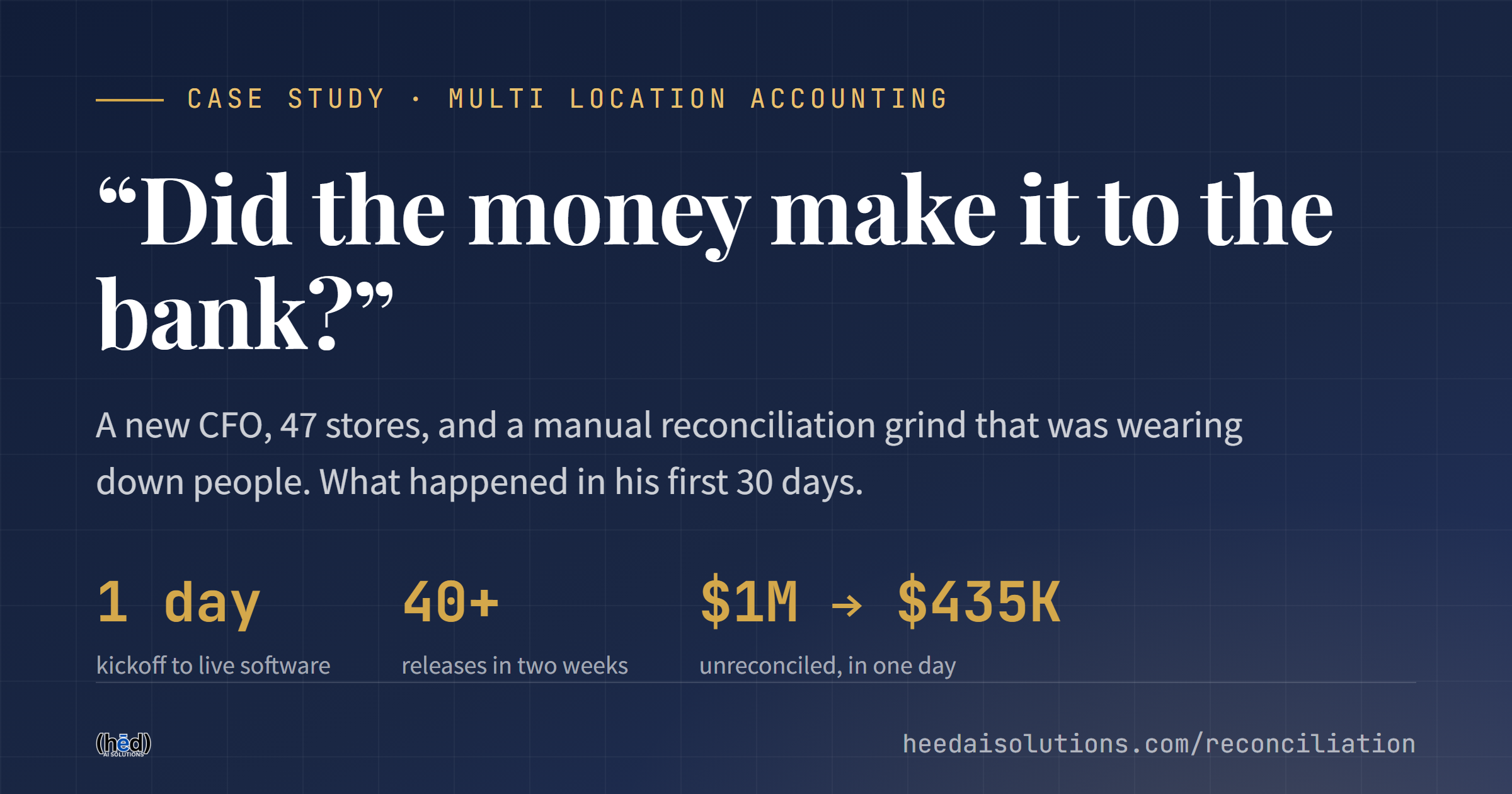
The kickoff working session with the accounting team happened July 1. The next day, July 2, the team was logging into a live, secured reconciliation portal. Not a mockup, not a proof of concept deck: a working dashboard behind enterprise grade access control, showing their stores, their deposits, and their gaps.
From there the build ran the way Heed always runs: the people who do the work became the designers. Two veterans of the accounting team, one with more than a decade at the company, turned the rules in their heads into the engine's rules. Cash grace amounts and realistic deposit windows. Weekend bundles and holiday shifts. The store with its own bank account. The financing program that funds the whole company in one deposit, net of fees, decomposed back to per store expectations to the penny.
When the CFO reviewed the manual matching feature, his instinct became a design rule: if a link is off by even a few dollars, the system should say so and ask before proceeding. The senior accountant contributed the law the whole system now lives by: it must be accurate, never a guess.
The back and forth was the method
This was not a build handed over a wall. It was a conversation with software in the middle. On July 8, a morning walkthrough produced five requests, and all five were live by that evening. That same night, an upload mystery was diagnosed remotely: the bank file had been pasted without its header row. Instead of asking the team to change, the system learned to read headerless files, renamed files, merged cells, and duplicate uploads, and to say out loud exactly what it read and what it ignored. No silent failures, ever.
On July 14, a morning call about upload errors turned into funding day rules, next day netting, write off workflows, and an unpair button, live that afternoon. On July 15, the team worked the tool all day and the numbers moved: more than one million dollars of unreconciled deposits dropped to 435 thousand. In one day. More than 40 numbered releases shipped between July 8 and July 20. The feedback loop was hours, not sprints.
What the engine does now
- Every store, every day, every payment type matched to the bank automatically on its real funding calendar.
- Exceptions that explain themselves, down to pinning a shortage to the single invoice that caused it so a store can make one phone call.
- Real money caught: two processor funding shortfalls, $607.58 and $862.19, documented to the penny, and more than $100,000 of historical deposits flagged for investigation across two months.
- One click resolution with a full audit trail: link, offset, write off, unpair, every action attributed and reversible.
- A built in escalation ladder: unresolved items move to the team at day three and leadership at day five. The president sees one short list.
- Uploads that police themselves: daily checklists, staleness warnings, gap detection by store and day, and no silent overwrites.
Because the engine is deterministic, the numbers are never AI guesses. The matching is exact math with written rules. AI is what let Heed build and refine it at this speed, and it powers the assistant inside the dashboard that answers questions in plain English. Judgment stays with people.
“So we can just breathe.”
The controller, when we described the goal of giving the team reliefWhy this worked
Heed builds solutions because we understand business, technology, and people, and we connect all three. Business: the engagement started with deposit windows, fee math, and escalation policy, not with technology. Technology: the engine sits on top of the systems the company already owns, nothing ripped out, nothing installed, secured behind zero trust access, for a company with no in house IT. People: the veterans who carry the work designed it with us, and their mornings are the proof.
This reconciliation engine is the first of many. The same approach is already pointed at month end, real time processor feeds, and the operational and management dashboards that come next.